
If you have stuck-up kneecaps you’re at risk of having knee pain, hip pain, or other joint-related problems. According to the CDC in 2009, the total knee replacements in the US equaled 676,000 and total hip replacements equaled 327,000! Of the 676,000 knee replacements, 303,000 were between the ages of 45-64! And of the 327,000 hip replacements, 152,000 were between the ages of 45-64!
How can you tell if your kneecaps are stuck up? Stand with straight legs and try to lift and lower your kneecaps using your quadriceps. To do this you need to have fully extended knees (but not locked). Make sure your femurs are vertical (your pelvis isn’t out in front of you). Having trouble fully extending the knees? Tight hamstrings and calf muscles create a bent knee. Friction results when you walk with bent knees. More friction=inflammation=knee pain. If you can’t lift your kneecaps it’s because they’re already pulled up by the quadriceps, meaning you’re actually having trouble lowering the kneecaps. As a result, the upward pull of the quadriceps pulls your patellas (kneecaps) into the tissue behind creating wear and tear with every step you take.
Note: most of the people I see in person think they can let their kneecaps down, but in reality, they’re just slightly bending and straightening the leg instead of relaxing the quads. You want to be able to let the kneecaps down while keeping the leg straight. Try it in front of a mirror.
Still, can’t lift and lower your kneecaps? Try this:
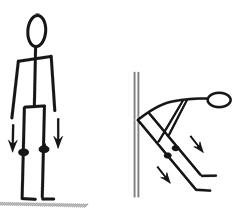
Let your kneecaps down to prevent knee pain. Source: Restorative Exercise™ Institute
Lean against a wall with your feet about 12 inches away from the wall. Try to lift and lower your kneecaps. Once you achieve the kneecap release at this distance move your feet a little closer to the wall until you can do the release while standing in vertical. The kneecap release is not an exercise, it’s a test to see if you can relax the quadriceps. It’s a way that I check myself while standing at a crosswalk, at my standing workstation, or in a grocery line.
It took me a week to get my left kneecap to release. You can see it lagging behind a bit in the tango. Make sure you have the sound on for the full tango effect. 🙂






So is it possible to only be able to relax your kneecaps part way? Or is it an all or nothing kind of deal?
Hi Marcee, Yeah my left kneecap would only release a little at first, but you want to work on getting the quads to release completely.
Wow. So I’ve just got to extrapolate: the common yoga instructions to “activate your quadriceps” and “make your quadriceps smile” is actually encouraging over the long-term, degeneration in the hips and knees?? And while I’m on it, what about, “tuck your coccyx”?? Thanks!
Hi Elizabeth, I’m not familiar with those yoga instructions, so I’m not sure why your yoga instructor is asking you to activate your quads. You may want to ask her/him why. You should always know why you do something in regards to your body. Just remember your habits become your posture. The more you put your body into a certain position the sarcomeres of the muscles shorten and keep the muscles a shorter length causing friction at the joints (and restrict blood flow resulting in cellular degeneration). So, I’m definitely not a fan of tucking the coccyx either. I’m a fan of using your body the way it’s designed to be used. The alignment marker for the pelvis is ASIS and pubic symphysis in vertical alignment. When you tuck, you change pelvic floor dynamics and take the natural curve out of the lumbar spine.
Hi, we – older yoginis – have been tought to lift the knee caps and activate the quads. Now the knee caps stay nicely up and seems to demand lots of work to bring them down while standing – sitting is fine.
But what comes to reciprocity of the muscles should we activate the quads while trying to lengthen the hamstrings?
Tucking the tail was also one of the cues we had to learn, and it is still taught in some yoga schools.
Lovely to get these information to undo the blockages and let the body relax and be natural.
Many thanks!
Very confused. All yoga classes teach to lift the knee caps by tightening the quads.
I’m wondering if the quads are required in the specific yoga poses? I would ask your yoga instructor why he/she wants you to lift the knee caps/tighten the quads. Is it constant during and outside of yoga? Just for certain poses? The main take away from this post is that you shouldn’t be walking around with your quads constantly pulling your knee caps up. This creates wear and tear on the area behind the patella, and doesn’t allow you to fully engage the correct muscles for walking in alignment.
I am currently enrolled in Yoga School . A 200 hour program. We have been taught to raise the knee caps and engage the quads. This also helps to raise the arch of the foot and prevents knee locking.
I must know the source/name of this music!
Hi Angie,
It sounds like the end goal you are describing is to externally rotate the femurs which raises the arches. The problem is that external rotation of the femurs should happen with the lateral rotators, not the quads. It seems to me that to prevent locking of the knees you would want relaxed quads and kneecaps down (unlocked). Many folks mistake locked knees with internal rotation of the femurs.
http://www.tangoberretin.com/tango-cds-dvds-and-gift-certif/ Berrentine
Hi there! I’ve been reading a lot of your posts as I learn more about Restorative Exercise. My knee caps do not want to move at all – is there hope for a super-tight kneed person? I just did Katy Bowman’s Save Your Knees course and will be doing her exercises, but I’m a little daunted by how immoveable my knee caps are! I remember being able to move them easily as a kid. Any feedback would be appreciated! Thanks for the work you do!
Hi Lily, Yes, there is hope! It took me a whole week to get my left one to release. When you lean against the wall to practice releasing them, give the quads a little shake with one hand. Also, make sure your weight isn’t forward as you move about your day. Send the signal to relax the quads anytime you are standing in line at the grocery store, at your standing work station, etc. Let me know how it goes….oh yes, and do the Quads and Hams Alignment Snacks.
Hi Barbara, Thanks for the information! I’ve noticed that I can
release the knee caps when bending the torso forward, and I can
even manage to keep them relaxed when externally rotating the
femurs from this position. However, when I stand completely upright it is much more difficult to relax them and even more so if I try to externally rotate femurs What is happening here? Why can I do it bent over but, not standing all the way up? Is this a Psoas issue? Thanks!
Hi Barbara! It’s about a month later and I wanted to update you on my progress. After about a week, I was able to begin to release my knees – more easily on the left than the right. Now I have been able to integrate it into my daily movement as it’s gotten much easier over time! Honestly, I was thrilled when I first saw my “immoveable” knee cap relax!
I’ve been doing Katy’s exercises and my hamstring and hip flexibility is slowly increasing. I’ve been socking some $$ away to pay for the Restorative Exercise prerequisite pack so I can sink my teeth in even more. Thanks for your helpful posts. 🙂
Wonderful news Lily! Congrats on getting the kneecaps down. RE has been one of the better investments I’ve made in my own health. Thanks for the update!
I have the exact same issue. I have worked on my left knee and it has improved but the kneecap will not relax when I stand upright. Just wanted to bump this topic and see if anyone could suggest a tactic/s?
I can’t seem to move my knee caps like this video and text explains and I am concerned! Maybe I don’t know how to do it right? How do you do it without hurting yourself when trying to do it? I think I used to be able to do it.
Also, I have been really stressed lately.
I recently realized that I have very tight quads (especially when compared to my hamstrings). I wasn’t able to get them to release when standing but when I tried it sitting on the floor (legs straight) I was able to move them. Does that count?
That’s a start, but ideally you should be able to get them down while standing. If they are stuck up during standing and walking, that creates friction behind the knee with every step. Try leaning against the wall and shaking your quad with your hand. …it will happen with practice.
Hi
In Qi Gong, the directions for standing are to stand with a bend in the knees. It use to feel okay.
Recently I became aware of my constant lifting of my kneecaps. It has taken lots of work to learn how to release them.
I like Qi Gong. But now the standing instruction to “stand with a bend in the knee” no longer feels right to me.
Do I give up Qi Gong?
I mostly walk and do stretches that I am learning from Katy Bowman’s dvds.
I had practiced yoga daily for over 30 years. That practice has evolved tremendously as I learn about natural movement.
I will appreciate any insights about standing with a bend in the knees when practicing Qi Gong (horse stance).
Thank you,
Patricia
Hi Patricia, I too practice Qi Gong daily. It’s ok to bend knees for horse stance and helps us ground and direct energy,the issue arises when people keep a slight bend in the knees all the time while standing throughput the day. Your Qi Gong practice may amount to 15-60 minutes a day with varied movements. What you are doing the bulk of the day makes the most difference.
I am looking at knee surgery and hip surgery and stumbled across your site. I know nothing of what you all speak of. I have never done yoga. My knee caps will not move at all.